Where Does Food Waste Go After It Is Collected?
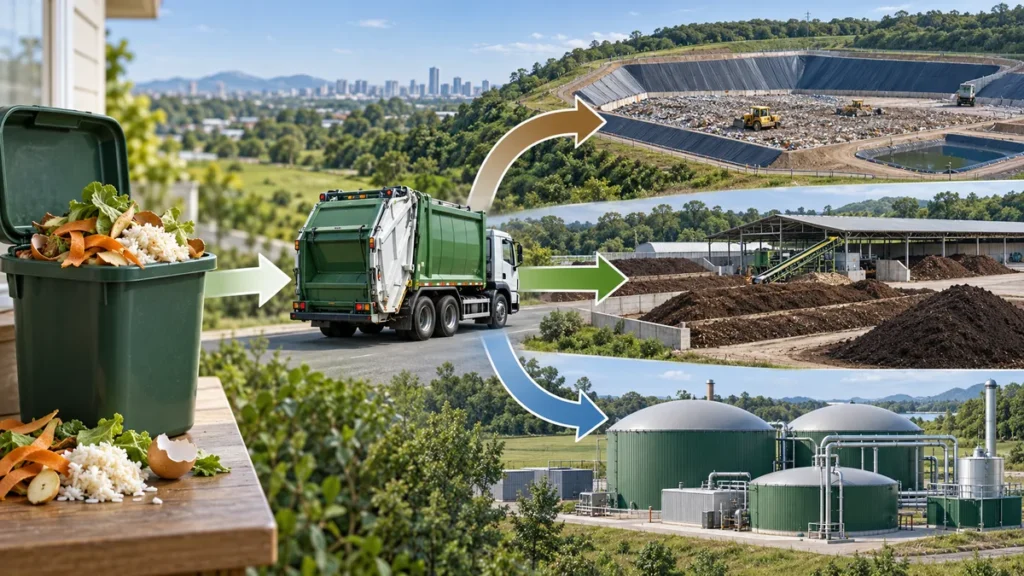
Kredit imej: Nilam Online / Edura Creative — ilustrasi dijana dengan AI
🏫 Sokong sekolah anda dalam Liga Membaca Nilam Online
Pilih sekolah anda supaya bacaan anda nanti boleh membantu sekolah naik dalam ranking bulanan.
🏫 Sekolah Anda
Anda masih boleh membaca tanpa memilih sekolah.
Taip sekurang-kurangnya 2 aksara, kemudian pilih sekolah daripada hasil carian.
You scrape the last spoonful of rice from a plate into the rubbish bin.
A banana peel follows.
Then a few vegetable scraps.
The bag is tied, carried outside and eventually collected by a waste truck.
For most of us, that is where the story ends.
But the food has not disappeared.
It has simply moved somewhere else.
Depending on how a town manages its waste, discarded food may end up in a landfill, a composting facility, an anaerobic digester, a treatment plant or another waste-management system.
What happens next matters.
Food waste contains water, nutrients and organic carbon. If it is managed well, some of those materials can be returned to the soil or used to produce energy. If it is simply buried with other rubbish, the food may decompose in conditions that produce methane, a powerful greenhouse gas.
In Malaysia, food waste remains an important part of the waste stream. A KPKT study of waste disposed of at 27 landfill sites in 2021 found that food waste made up about 36% of the total waste examined.
So the question is not only:
Why do we waste food?
It is also:
What happens to that food after the bin is collected?
1. The journey depends on which bin the food enters
Imagine two banana peels.
The first is thrown into a rubbish bag together with:
- plastic packaging;
- tissues;
- drink containers;
- broken items;
- other household waste.
The second is placed in a separate container for organic waste.
They look exactly the same.
But their journeys can be very different.
The first peel may travel with mixed municipal waste towards a landfill.
The second may be sent for composting or another form of organic-waste treatment.
This is why separation at the source is so important.
Once food scraps are mixed with plastics, chemicals and general rubbish, recovering them cleanly becomes much more difficult.
2. First stop: the collection truck
Waste collection may look simple from the outside.
A truck arrives.
Workers collect the bins.
The truck leaves.
But the collection stage is an important part of the system.
The truck may carry waste:
- directly to a disposal site;
- to a transfer station;
- to a treatment facility;
- to a recycling or organic-waste centre.
In densely populated areas, taking every small collection truck directly to a distant landfill may be inefficient.
Instead, waste can be brought to a transfer station.
There, loads from several collection vehicles may be combined into larger vehicles for the next part of the journey.
The waste has still not been treated.
It has only been reorganised for transport.
3. Mixed food waste often travels with general rubbish
If food scraps have been thrown into an ordinary rubbish bin, they are usually no longer treated as clean food material.
They become part of the general waste stream.
The bag may contain:
a mango peel,
a disposable cup,
a broken pen,
leftover noodles,
plastic wrapping,
and a used tissue.
Separating all of those materials later can be difficult, expensive and sometimes impractical.
Malaysia's waste-management authorities have repeatedly highlighted the amount of food waste reaching disposal sites. SWCorp also describes food waste as one of the major types of waste being sent to landfills.
For mixed food waste, one common destination is therefore the landfill.
4. What actually happens in a landfill?
A landfill is not simply a giant hole into which rubbish disappears.
A modern sanitary landfill is designed to manage waste in a controlled way.
Waste is placed in designated areas, compacted and covered.
Engineering systems may also be used to manage:
- rainwater;
- leachate;
- landfill gas;
- environmental monitoring.
But burying organic waste creates a special problem.
Food contains carbon.
Microorganisms begin breaking it down.
At first, some oxygen may still be present.
As the waste becomes buried and oxygen is used up, decomposition increasingly occurs under anaerobic conditions — conditions without oxygen.
One of the gases produced is methane.
The U.S. Environmental Protection Agency notes that food decomposing anaerobically in landfills generates methane and that landfilled food can make a disproportionately large contribution to landfill methane emissions.
The chemistry does not change simply because the landfill is in another country.
Organic matter buried in low-oxygen conditions can generate methane wherever those conditions occur.
5. Why is methane important?
Methane is a greenhouse gas.
It remains in the atmosphere for a shorter period than carbon dioxide, but it is very effective at trapping heat.
This means that preventing unnecessary methane emissions can be important for climate protection.
There is another problem.
Food decomposes relatively quickly compared with materials such as plastic.
At some landfill sites, gas-collection systems are installed to capture methane.
The captured gas may be burned safely or, in some systems, used to produce energy.
But not every molecule of methane is necessarily captured.
EPA research notes that food can begin producing methane before landfill gas collection systems capture all of it.
So although landfill-gas recovery can be useful, it does not make wasting food harmless.
6. A landfill also produces liquid waste
Gas is not the only concern.
Think about rainwater entering a large mass of rubbish.
Water moves through decomposing materials.
Along the way, it can pick up dissolved substances and contaminants.
The resulting liquid is known as leachate.
Properly engineered landfill systems need to collect and treat leachate so that it does not contaminate surrounding soil or water.
Malaysian guidance on food-waste treatment identifies leachate, odour, pests and greenhouse gases among the environmental problems associated with decomposing food waste at disposal sites.
Again, the lesson is simple:
Throwing food “away” does not remove it from the environment.
Someone still has to manage what happens next.
7. What if the food waste is collected separately?
Now return to our second banana peel.
Suppose it was placed into a dedicated food-waste container.
It has not been mixed with plastic wrappers, batteries or general rubbish.
That makes more treatment options possible.
One of the best-known is composting.
Composting uses microorganisms to break down organic materials under controlled conditions where oxygen is available.
Food scraps may be mixed with carbon-rich materials such as:
- dry leaves;
- wood chips;
- garden waste.
With suitable oxygen, moisture and temperature, microorganisms gradually transform the mixture into a stable material called compost.
8. What does compost become?
Finished compost looks very different from the banana peel that entered the system.
The original scraps are no longer recognisable.
The material can be used to improve soil.
Compost can help:
- return organic matter to soil;
- improve soil structure;
- support plant growth;
- improve the soil's ability to hold water.
Instead of carbon and nutrients being buried in a landfill, some of those materials are returned to the land.
This is why composting is often described as a form of organic recycling.
Malaysia has also used community composting initiatives. SWCorp reported, for example, a Compost@Community programme in Pahang that converted food waste into compost for agricultural use.
9. Composting still requires careful management
Composting does not mean simply making a pile of food and waiting.
An unmanaged heap of wet food can:
- smell;
- attract pests;
- become too wet;
- lose oxygen.
Successful composting requires suitable conditions.
Microorganisms need a balance of:
food + moisture + oxygen + temperature + suitable material structure.
Large facilities may regularly turn compost piles or use aeration equipment.
Some systems monitor temperature carefully.
The aim is to create conditions in which organic material decomposes efficiently rather than becoming a foul-smelling anaerobic mass.
10. Contamination can ruin organic recycling
Imagine a load of separated food waste containing:
- plastic forks;
- drinking straws;
- metal cans;
- glass;
- plastic bags.
The facility now has another problem.
Those materials do not simply transform into compost.
They have to be removed.
Tiny pieces may be especially difficult to separate.
This is one reason source separation matters so much.
A composting system is most useful when the incoming organic waste is reasonably clean.
EPA guidance notes that materials sent for composting should be kept free from contaminants such as non-compostable packaging.
So the success of a composting facility begins long before the waste arrives.
It begins with the person standing beside the bin.
11. Another destination: an anaerobic digester
Food waste can also be processed without oxygen — but in a controlled system designed to recover useful products.
This process is called anaerobic digestion.
Inside a sealed digester, microorganisms break down organic matter in the absence of oxygen.
The process can produce:
biogas
and
digestate.
Biogas contains methane that can be captured instead of simply escaping into the atmosphere.
Depending on the system, that gas can be used as a source of energy.
Digestate is the material remaining after digestion and can potentially be managed for beneficial uses such as soil improvement, subject to its quality and local requirements.
12. Is landfill methane the same as digester biogas?
Chemically, methane may be part of both gases.
But the systems are different.
At a landfill, methane is an unwanted result of buried organic waste decomposing.
Operators may try to collect it.
In an anaerobic digester, gas production is deliberately managed inside a controlled vessel.
Think of the difference this way.
A leaking tap produces water accidentally.
A hydroelectric system moves water deliberately to recover useful energy.
Both involve water, but the management is different.
Similarly, anaerobic digestion attempts to turn decomposition into a controlled resource-recovery process.
13. Malaysia has considered food waste as a resource
This idea is not completely new in Malaysia.
JPSPN's food-waste management planning for industrial, commercial and institutional sectors has recognised centralised treatment that can convert food waste into useful outputs such as fertiliser and biogas, while waste that cannot be treated still requires appropriate disposal.
This illustrates an important change in thinking.
Instead of asking:
“How do we get rid of this waste?”
a circular system asks:
“Is there anything useful still inside this material?”
For food waste, the answer may include:
- nutrients;
- organic matter;
- energy.
14. What about food that is still edible?
There is an even better option than composting.
Do not turn edible food into waste in the first place.
Imagine a bakery ending the day with twenty loaves that are still safe to eat.
If suitable systems exist, keeping those loaves for human consumption preserves far more of their value than grinding them into compost.
EPA's Wasted Food Scale places preventing wasted food among the most environmentally beneficial actions because producing food already uses:
- land;
- water;
- energy;
- fertiliser;
- transport;
- labour.
When edible food is discarded, those resources have already been used.
So the most sustainable waste-management truck may sometimes be the one that never needs to collect the food at all.
15. Some food by-products can have other uses
Depending on the material, regulations and local facilities, certain food by-products may be:
- processed for animal feed;
- converted into industrial materials;
- treated biologically;
- used for energy recovery.
But not every discarded food item is suitable for every pathway.
Safety matters.
A clean by-product from a food-processing factory is very different from a bag of mixed household rubbish containing food, plastic and cleaning products.
This is why proper waste classification and treatment systems are important.
The word food waste actually covers many different materials.
16. What about incineration?
Some municipal waste systems use controlled combustion or incineration.
In such systems, mixed waste may be burned at high temperatures, sometimes with energy recovery.
However, food waste contains a large amount of water.
Wet material is generally less attractive as a fuel because energy must first be used to heat and evaporate that water.
EPA therefore places incineration among the less preferred food-waste pathways and notes that wet food is a relatively poor combustion feedstock compared with many other types of municipal waste.
This does not mean all waste-to-energy systems are identical.
Their performance depends on technology, waste composition and operating conditions.
But it does explain why keeping wet organic waste separate can sometimes improve the options available for managing it.
17. Should we wash food down the drain?
Imagine leftover soup being poured into the sink.
It may feel as though the waste has disappeared.
It has not.
It has simply entered the wastewater system.
Food solids and especially fats, oils and grease can create problems in pipes and treatment systems.
EPA warns that fats, oils and grease can block pipes and pumps.
Wastewater treatment facilities may be able to process some organic matter, and some facilities use anaerobic digestion.
But household drains should not be treated as invisible rubbish bins.
The correct disposal method depends on local infrastructure and guidance.
18. Why does collection design matter so much?
Suppose a city owns an excellent composting facility.
But every household throws food into the same bag as ordinary rubbish.
The compost plant may receive very little clean food waste.
Now imagine the opposite.
Households have a food-waste bin, but there is no vehicle to collect it separately.
Again, the system cannot work properly.
Successful food-waste recovery therefore requires several parts to connect:
people → bins → collection → transport → treatment → useful output
If any link is missing, material may still end up in landfill.
Infrastructure and human behaviour must work together.
19. Does every place use the same system?
No.
A large city and a rural district may have very different options.
One place may have:
- sanitary landfills;
- composting facilities;
- transfer stations;
- anaerobic digesters.
Another may have fewer treatment facilities.
Waste-management decisions also depend on:
- distance;
- cost;
- population;
- land availability;
- local laws;
- collection systems;
- existing infrastructure.
That is why we should be careful with statements such as:
“Food waste always goes to compost.”
or
“All food waste goes to landfill.”
The correct answer is:
It depends on how the local waste system collects and treats it.
20. What happens when food waste is mixed with everything else?
Think again about contamination.
An orange peel is biodegradable.
A glass bottle is not.
A plastic wrapper behaves differently.
A metal can behaves differently again.
When everything is mixed, the waste-management system inherits the job of separating materials — if separation is even practical.
When materials are separated earlier, each stream can be directed towards a treatment process better suited to it.
This is one reason waste management increasingly focuses on the idea that:
The bin is not the end of the product's life. It is the beginning of its next pathway.
21. Why preventing waste is better than treating it
Suppose we grow one kilogram of vegetables.
Water is used.
Land is used.
Fertiliser may be used.
Workers harvest the crop.
A truck transports it.
A refrigerator keeps it cool.
A shop stores it.
Then nobody eats it.
Even if we compost the vegetables perfectly, we do not recover all the resources used to produce and distribute them.
Composting recovers organic matter.
Anaerobic digestion may recover energy.
But neither can give back every litre of irrigation water or every kilometre of transport already used.
That is why waste prevention comes first.
Treatment is important for the waste we cannot avoid.
But preventing edible food from becoming waste is usually better.
22. What can households actually do?
A household does not control the entire waste system.
But it controls what enters the bin.
Useful actions include:
- plan meals;
- check food before buying more;
- understand storage instructions;
- use leftovers safely;
- buy realistic quantities;
- separate organic waste where a suitable collection system exists;
- compost appropriate scraps if practical.
Not every household can operate a compost system.
Not every town offers separate food-waste collection.
So the first action available almost everywhere is also the simplest:
Waste less food.
23. The rubbish truck is not the end of the story
Tomorrow morning, a waste truck may collect hundreds of rubbish bags.
From the roadside, they may all look similar.
But inside those bags may be kilograms of food that took months to grow and only minutes to throw away.
After collection, that food may be:
buried,
composted,
digested,
burned with other waste,
or processed in another system.
The environmental result can be very different depending on the pathway.
Food buried in a landfill can generate methane.
Food composted properly can return organic matter to soil.
Food processed through anaerobic digestion can produce biogas.
Food that was never wasted at all does not need any of those systems.
So the journey from plate to bin is not really the end.
It is a decision point.
And the best outcome begins even earlier — before good food becomes waste.
Uji Kefahaman
Cuba jawab tanpa melihat semula terlebih dahulu.
Aktifkan JavaScript untuk menjawab kuiz interaktif.
Fikir & Jawab
Bina Rumusan Anda
Cuba tulis 2–3 ayat menggunakan perkataan sendiri.
- Why can two identical banana peels have very different environmental impacts after collection?
- Why does food buried in a landfill produce methane?
- How is composting different from anaerobic digestion?
- Why can contamination make food-waste recycling difficult?
Why is preventing food waste usually better than treating it after disposal?
Catatan ini tidak dihantar atau disimpan oleh Nilam Online. Salin catatan sendiri sebelum meninggalkan halaman jika mahu menyimpannya.
Maklumat Bacaan
- Tajuk
- Where Does Food Waste Go After It Is Collected?
- Pengarang
- Rifqi Mk.
- Penerbit
- Edura Creative
- Tahun
- 2026
- Bahasa
- Bahasa Inggeris
- Jenis
- Artikel Web
Salin secara manual
Anda akan dibawa ke portal rasmi AINS dalam tab baharu. Nilam Online bukan portal rasmi AINS atau KPM.
Sumber bacaan
- Kempen JomTapau 25 April 2022 ↗ — KPKT
- Compost@Community ↗ — SWCorp
- Solid Waste Management Facilities ↗ — SWCorp
- Pelan Pembangunan Pengurusan Sisa Makanan ICI ↗ — JPSPN
- Composting ↗ — US EPA
- Frequent Questions about Anaerobic Digestion ↗ — US EPA
- Wasted Food Scale ↗ — US EPA