How Does a City Use Water?
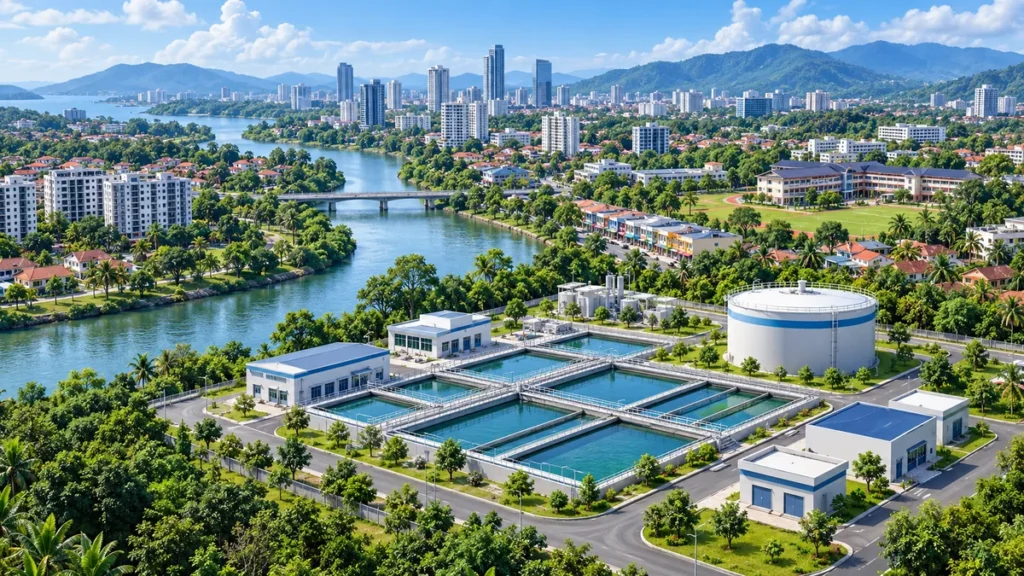
Kredit imej: Generated for Nilam Online — Edura Creative
🏫 Sokong sekolah anda dalam Liga Membaca Nilam Online
Pilih sekolah anda supaya bacaan anda nanti boleh membantu sekolah naik dalam ranking bulanan.
🏫 Sekolah Anda
Anda masih boleh membaca tanpa memilih sekolah.
Taip sekurang-kurangnya 2 aksara, kemudian pilih sekolah daripada hasil carian.
Turn on a tap in a city.
Within seconds, water flows out.
We use it to drink, cook, wash our hands and clean our homes.
It feels simple.
But behind that tap is a huge system of rivers, treatment plants, reservoirs, pumps and underground pipes.
And homes are only one part of the story.
A city also needs water for schools, hospitals, restaurants, factories, parks, fire stations and many other activities.
Public water systems commonly supply water for domestic, commercial, industrial and public purposes. Public uses can include firefighting, parks and municipal facilities.
So when millions of people live close together, supplying water becomes one of the city's most important jobs.
Water Does Not Begin at the Tap
Where was your tap water before it reached your house?
In many urban water systems, the journey begins with raw water from sources such as:
- rivers;
- lakes;
- reservoirs;
- groundwater.
In Selangor, Kuala Lumpur and Putrajaya, for example, rivers are important sources of raw water. Water is taken from these sources, treated at water treatment plants and then distributed to consumers.
The water coming from a river cannot simply be pumped straight into every home.
It first needs to be treated.
Step 1: Taking Water from the Environment
The first stage is called abstraction or intake.
Raw water is taken from a source and brought into the treatment system.
Large objects such as:
branches,
leaves,
plants,
and other debris
may first be screened out.
Air Selangor's description of its treatment process begins with raw water intake before the water moves through several treatment stages.
But taking water from nature also creates a responsibility.
A city cannot behave as though rivers contain an unlimited amount of clean water.
The quality of the source matters.
If a river becomes badly polluted, treating the water can become more difficult.
That is why protecting rivers and catchment areas is connected directly to urban water security.
Step 2: Making the Water Safe
Raw water may contain:
- soil particles;
- organic matter;
- microorganisms;
- unwanted substances.
Treatment plants use several processes to improve water quality.
The exact system can differ from place to place, but common stages include:
coagulation and sedimentation → filtration → disinfection
During coagulation and sedimentation, small particles can be brought together so they become easier to remove.
Filtration then passes the water through filtering material to remove smaller particles and impurities.
Finally, disinfection is used to reduce harmful microorganisms.
Air Selangor describes a treatment sequence that includes pre-treatment, coagulation, sedimentation, filtration and disinfection before treated water is distributed.
So a glass of city water may have passed through several carefully controlled stages before reaching you.
Step 3: Storing Treated Water
A city does not usually send every litre directly from the treatment plant to a tap.
Treated water can first enter reservoirs or storage facilities.
Why?
Imagine that thousands of people wake up at nearly the same time.
Showers are turned on.
Kettles are filled.
Restaurants begin preparing food.
Schools open.
Demand suddenly increases.
Storage helps the system respond to these changing needs.
Air Selangor describes treated water being stored in service reservoirs before entering the distribution network.
You can think of reservoirs as part of the city's water buffer.
They help keep supply available while demand rises and falls.
Step 4: Water Travels Through a Hidden Network
Much of a city's water system is invisible.
Under roads and pavements are kilometres of pipes.
Pumps help move water where needed.
Valves control sections of the network.
Meters measure use.
Reservoirs maintain supply.
The distribution system must also reach areas at different elevations.
A building near a treatment plant may not receive water in exactly the same way as a neighbourhood on higher ground.
Air Selangor notes that pipelines, pump stations and reservoirs are all part of the system needed to deliver treated water to consumers.
A working city therefore depends partly on infrastructure most people rarely see.
Where Does the Water Go?
Once water enters the city, it travels to many different users.
1. Homes
At home, water may be used for:
- drinking;
- cooking;
- bathing;
- washing clothes;
- washing dishes;
- flushing toilets;
- cleaning;
- watering plants.
Domestic use is one major part of public water demand.
But a city cannot be understood by looking at homes alone.
2. Schools and Hospitals
Think about a school.
Water is needed for:
toilets,
handwashing,
canteens,
cleaning,
drinking,
laboratories,
and sometimes gardens or sports facilities.
Now think about a hospital.
Water is needed for hygiene, cleaning, food preparation, sanitation and many clinical and support activities.
A reliable water supply therefore affects far more than comfort.
It is part of public health and daily city operations.
3. Shops, Restaurants and Offices
Businesses also depend on water.
A restaurant uses water to:
- prepare food;
- wash equipment;
- clean surfaces;
- support toilets and handwashing.
Hotels need water for rooms, kitchens, laundry and cleaning.
Offices may use less water than some industries, but thousands of office workers still create demand through toilets, sinks, cafeterias and maintenance.
Public-supply systems commonly deliver water to commercial users as well as households.
4. Factories and Industry
Some industries use water in manufacturing.
Water may be needed for:
- washing;
- cooling;
- processing;
- producing steam;
- making products.
Different industries use very different amounts.
A small workshop and a large food-processing plant will not have the same water needs.
Some factories may also have their own water sources or treatment systems, depending on location and regulations.
This shows why urban water planning must consider more than population alone.
The type of economic activity in a city also matters.
5. Parks and Public Spaces
A city may use water for:
- public gardens;
- landscaping;
- sports fields;
- swimming pools;
- cleaning some public facilities.
USGS classifies parks, pools and municipal facilities among public uses of supplied water.
But this also raises an important question:
Should drinking-quality water always be used for every task?
That question becomes more important as cities search for ways to conserve water.
6. Firefighting
Firefighters may need very large amounts of water in a short time.
Fire hydrants are connected to water-distribution networks so emergency crews can access water rapidly.
This means a city's system must be designed not only for normal daily demand but also for emergencies.
Public water use therefore includes firefighting and flushing of hydrants and water lines.
A reliable water network is part of a city's emergency infrastructure.
Does All Water Reach a User?
No.
Some water can be lost before it reaches a tap.
Imagine a pipe buried underground develops a crack.
Water may leak for hours or even days before the problem becomes visible.
Other differences between supplied and billed water may come from:
- damaged pipes;
- inaccurate meters;
- system flushing;
- maintenance activities.
Water that enters a supply system but does not result in normal billed consumption is often discussed under the idea of non-revenue water.
USGS notes that differences between water supplied and billed deliveries can include leakage, meter errors and public uses such as firefighting and system flushing.
Reducing leakage can therefore save water without asking people to stop using water for essential needs.
A Leak Can Be Small but Continuous
Imagine a pipe leaking only a little water every minute.
That may not look serious.
But the leak continues:
minute after minute,
hour after hour,
day after day.
Over a long period, the total loss can become large.
This is why water utilities need:
- monitoring;
- pressure management;
- pipe inspection;
- repairs;
- replacement of ageing infrastructure.
Water conservation is not only the responsibility of households.
The system itself must also operate efficiently.
What Happens After We Use the Water?
Consider a shower.
Clean treated water comes from the tap.
You use it.
Then it disappears down the drain.
Has the water vanished?
No.
It has become wastewater.
The same happens when we:
- flush a toilet;
- wash dishes;
- wash clothes;
- use sinks.
In many urban areas, wastewater enters underground sewer pipes.
These pipes carry sewage towards treatment facilities.
In Malaysia, Indah Water Konsortium operates and maintains sewerage systems in many areas. Connected premises send sewage through sewer pipelines to sewage treatment plants.
Why Can't Sewage Go Straight into a River?
Wastewater can contain:
- human waste;
- food residues;
- soaps;
- oils;
- organic matter;
- microorganisms;
- other pollutants.
Releasing untreated sewage directly into waterways could damage the environment and create health risks.
That is why cities need sewage treatment plants.
A typical treatment system can involve screening, removal of grit and grease, biological treatment and settling processes before treated effluent is released.
Treatment plants also monitor the quality of the water they discharge.
IWK explains that treated effluent is sampled and tested so that it meets required standards before entering receiving waters.
Clean Water In, Wastewater Out
We can now see two different networks.
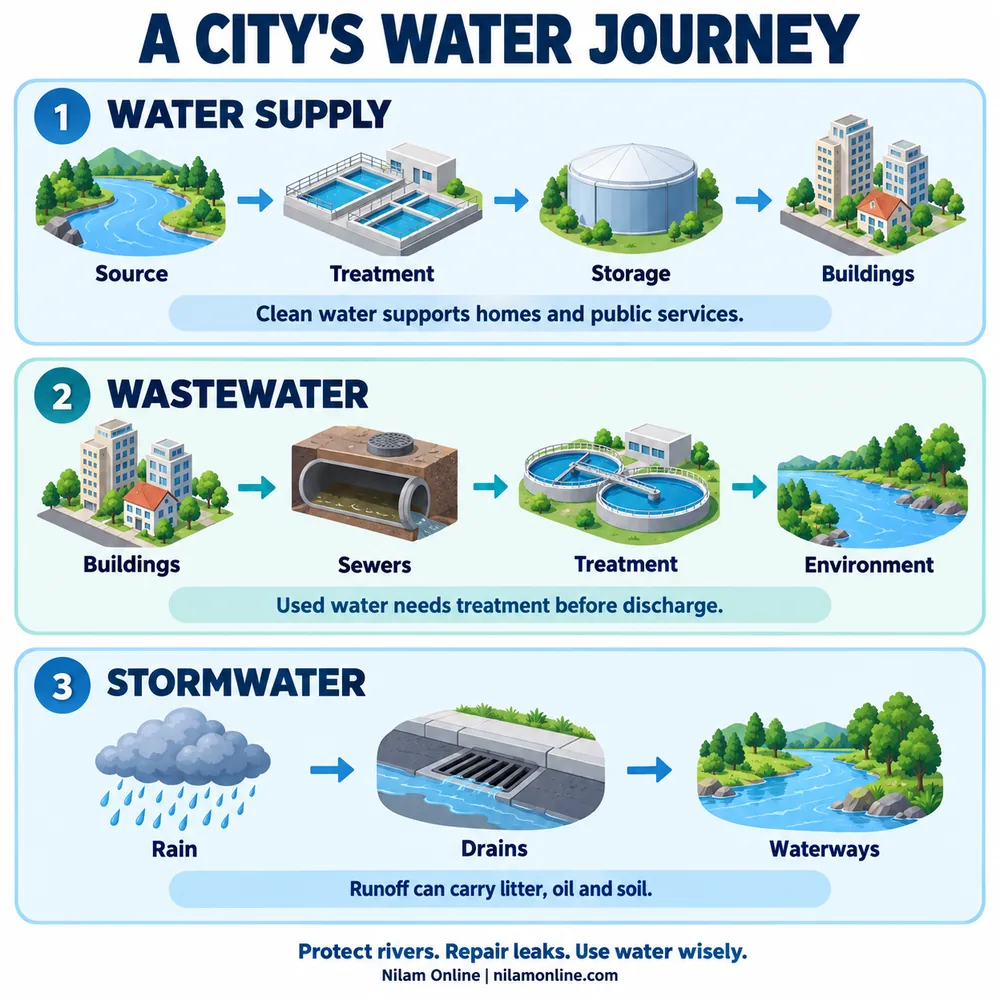
Water supply network
River/source → treatment plant → reservoir → pipes → buildings
Sewerage network
Buildings → sewer pipes → sewage treatment plant → treated effluent
These systems may both contain water, but they have very different purposes.
One brings treated water into the city.
The other safely carries used water away for treatment.
Confusing the two would create serious problems.
What About Rain?
Rain creates another type of urban water flow.
When rain falls on a forest, some water can soak into the soil.
But cities contain many hard surfaces:
- roofs;
- roads;
- car parks;
- pavements.
Water cannot soak easily through these surfaces.
Instead, it runs across them.
This is called stormwater runoff.
Drains, canals, ponds and other structures help move or temporarily store stormwater.
Stormwater is not exactly the same as sewage.
However, rainwater flowing across streets can pick up:
oil,
litter,
soil,
and other pollutants.
So managing rain is also part of managing urban water.
Why Can Heavy Rain Still Cause Flooding?
A city may receive more rain than its drainage system can handle at one time.
Drains can also become blocked.
Rapid development can increase the amount of hard surface.
When less water can soak into the ground, more water moves quickly across the surface.
Urban planners therefore need to think about:
- drains;
- detention ponds;
- rivers;
- wetlands;
- permeable surfaces;
- green spaces.
A city's water system is not only about providing drinking water.
It also involves safely managing water when there is too much of it.
Can Cities Use Water More Than Once?
Increasingly, cities are interested in water reuse.
Not every task requires the same water quality.
For example, suitably treated reclaimed water may be useful for certain industrial or non-drinking purposes, depending on treatment standards and local rules.
IWK notes that its activities have expanded into resource-recovery areas involving bio-effluent and water reclamation.
This does not mean sewage water is simply sent back to taps.
Reuse requires appropriate treatment and careful control for the intended purpose.
The main idea is that used water can sometimes become a resource rather than being treated only as waste.
A City's Water Use Is a Cycle
Imagine one litre of water.
It begins in a river.
It enters a treatment plant.
It moves into a reservoir.
It travels through a pipe.
A family uses it to wash vegetables.
In a building connected to a sewerage system, the water enters a sink drain.
It moves through the sewer network.
A treatment plant cleans the wastewater.
The treated water eventually returns to the environment or, in certain systems, may be reused for an appropriate purpose.
Later, evaporation and rainfall continue the natural water cycle.
The city's engineered water system therefore sits inside the much larger natural water cycle.
Cities do not create water.
They borrow, treat, move, use and return it.
Why Does Population Growth Matter?
Imagine a town of 20,000 people becoming a city of 500,000.
More people mean more:
homes,
schools,
businesses,
restaurants,
hospitals,
toilets,
and wastewater.
But increasing supply is not as simple as installing more taps.
A growing city may need:
- larger treatment capacity;
- more reservoirs;
- stronger pumps;
- new pipelines;
- more sewage-treatment capacity.
Air Selangor's system, for example, involves raw water sources, treatment plants, reservoirs, pump stations and extensive pipelines to serve a large urban population.
Population growth therefore changes both water demand and infrastructure needs.
What Happens During a Water Disruption?
A city may sometimes experience a disruption because of:
- pipe damage;
- maintenance;
- treatment-plant problems;
- pollution of raw water;
- equipment failure.
Even after a treatment plant begins operating again, water may not immediately return everywhere.
Reservoirs and parts of the distribution network may need to refill and stabilise.
Air Selangor explains that after a water-treatment plant resumes operation, balancing and secondary reservoirs must be filled before supply can be fully distributed to consumers.
This shows how interconnected the system is.
Turning one treatment plant back on does not instantly fill every pipe in a city.
Why Protecting Rivers Matters
It is tempting to think:
“If water is dirty, the treatment plant will clean it.”
But treatment plants are not magical machines.
Highly polluted raw water may be harder or more expensive to treat.
Severe pollution can even interrupt treatment operations.
Protecting rivers therefore protects the first stage of the city's water system.
This includes controlling pollution from:
- industries;
- rubbish;
- sewage;
- land development;
- illegal dumping.
The cleaner the source, the stronger the foundation of the water-supply system.
What Can People Do?
Individuals cannot operate a city treatment plant.
But our choices still matter.
At home we can:
- repair leaking taps;
- turn off water while brushing teeth;
- take reasonable-length showers;
- run washing machines with suitable loads;
- avoid using a hose unnecessarily;
- report major leaks when noticed;
- avoid pouring oils or harmful chemicals into drains.
The goal is not to stop using water.
Water is essential.
The goal is to use it wisely.
Conservation Is Not Only About Shorter Showers
A city can also save water through better design.
Utilities can:
- detect leaks;
- repair pipes;
- improve meters;
- manage pressure;
- monitor water use.
Buildings can use:
- efficient taps;
- efficient toilets;
- water-saving equipment.
Landscaping can use plants that need less watering.
Industries can sometimes recycle water inside their own processes.
So water conservation has several levels:
individual → building → business → utility → city
Everyone is part of the system.
Water Has an Energy Cost Too
Water may look effortless when it comes from a tap.
But supplying it requires energy.
Energy can be used to:
- pump raw water;
- operate treatment plants;
- move water through networks;
- pump wastewater;
- operate sewage treatment.
If a city wastes treated water, it may also waste some of the energy used to treat and move it.
This is another reason why leaks matter.
A lost litre is not only lost water.
It may also represent wasted treatment and pumping effort.
The City Beneath the City
When we look at a skyline, we see:
apartments,
shops,
roads,
schools,
towers.
But beneath the ground is another city.
There are water mains carrying treated water.
There are sewer pipes carrying wastewater.
There are drains carrying stormwater.
There are valves, meters and pumps connecting the system together.
Without this hidden infrastructure, modern city life would be extremely difficult.
A city is therefore not only buildings above ground.
It is also the networks beneath our feet.
One Drop, Many Jobs
A single city's water supply supports many different activities.
Water keeps people hydrated.
It allows hospitals to operate.
It helps restaurants prepare food.
It supports factories.
It keeps schools clean.
It helps firefighters respond to emergencies.
It maintains parks and public facilities.
Then, after much of that water is used, another system must collect and treat the wastewater.
That is why urban water management is much more complicated than simply turning on a tap.
The tap is only the part we see.
Behind it is a continuous system that must:
collect → treat → store → distribute → use → collect again → treat again
And every stage depends on people, technology and a healthy environment.
The next time you fill a glass with water, you may be holding something that has travelled through one of the largest hidden systems in your city.
Activity After Reading
Map the Water Journey
Draw a simple city.
Include:
- one river;
- one water treatment plant;
- one reservoir;
- several homes;
- one school;
- one hospital;
- one fire hydrant;
- underground water pipes;
- sewer pipes;
- one sewage treatment plant.
Use blue arrows to show the journey of treated water.
Use another arrow style to show the journey of wastewater.
Then answer:
Why does a city need both a water-supply system and a sewerage system?
Uji Kefahaman
Cuba jawab tanpa melihat semula terlebih dahulu.
Aktifkan JavaScript untuk menjawab kuiz interaktif.
Fikir & Jawab
Bina Rumusan Anda
Cuba tulis 2–3 ayat menggunakan perkataan sendiri.
- Why must raw water usually be treated before being distributed through a city?
- Give three examples of how water is used outside homes.
- Why are reservoirs useful in an urban water-supply system?
- What is the difference between the water-supply network and the sewerage network?
How can repairing leaks help conserve both water and other resources?
Catatan ini tidak dihantar atau disimpan oleh Nilam Online. Salin catatan sendiri sebelum meninggalkan halaman jika mahu menyimpannya.
Maklumat Bacaan
- Tajuk
- How Does a City Use Water?
- Pengarang
- Rifqi Mk.
- Penerbit
- Edura Creative
- Tahun
- 2026
- Bahasa
- Bahasa Inggeris
- Jenis
- Artikel Web
Salin secara manual
Anda akan dibawa ke portal rasmi AINS dalam tab baharu. Nilam Online bukan portal rasmi AINS atau KPM.
Sumber bacaan
- Water Handbook ↗ — Air Selangor
- Water supply FAQ ↗ — Air Selangor
- Improving services and infrastructure ↗ — Air Selangor
- Public Water Supply ↗ — U.S. Geological Survey
- Public-supply water use and projections, Tennessee ↗ — U.S. Geological Survey
- Our Services ↗ — Indah Water Konsortium
- Effluent Standards ↗ — Indah Water Konsortium
- Sustainability Report 2012–2013 ↗ — Indah Water Konsortium
- Urbanization and Stormwater Runoff ↗ — U.S. Environmental Protection Agency
- Energy Efficiency for Water Utilities ↗ — U.S. Environmental Protection Agency