The Boy Who Planted Ten Trees
Kredit imej: NilamOnline / Edura Creative — ilustrasi dijana dengan AI.
The empty field behind Amir's house had once been green.
At least, that was what his grandfather always said.
“There used to be shade all the way to the old well,” Grandpa told him one evening.
Amir looked across the field.
There was no shade now.
The ground was dry in many places. Only a few patches of grass remained, and during hot afternoons, nobody wanted to walk across it.
“What happened to the trees?” Amir asked.
“Some fell during storms. Some were cut down when the road was widened. Others simply died.”
Grandpa sighed.
“Things change slowly. Sometimes we only notice when something is already gone.”
Amir looked again at the field.
For the first time, it seemed strangely empty.
The next morning, Amir found Grandpa behind the house holding a small black planting bag.
A young tree, hardly taller than Amir's knee, was growing inside it.
“What's that?”
“A rain tree sapling.”
“Where are you going to plant it?”
Grandpa pointed towards the field.
Amir laughed.
“One tree won't fill that whole place.”
“No,” Grandpa said. “But one tree is better than none.”
That answer stayed in Amir's mind all day.
At school, his teacher asked the class to think of one small thing they could do to improve their neighbourhood.
Some pupils suggested picking up rubbish.
Others wanted to paint old benches or make bird feeders.
When it was Amir's turn, he hesitated.
Then he said, “I want to plant ten trees.”
His friend Harith turned towards him.
“Ten?”
“Yes.”
“Why ten?”
Amir had not thought that far.
“Because one doesn't feel enough.”
The class laughed, but not unkindly.
His teacher smiled.
“Then your first task is not planting trees.”
Amir frowned.
“What is it?”
“Finding out where ten trees can safely grow.”
That afternoon, Amir ran home with a notebook.
“Grandpa, where can we plant ten trees?”
Grandpa raised an eyebrow.
“Ten?”
Amir nodded.
Grandpa looked at the field.
“Not wherever we like.”
He explained that trees needed space. They should not be planted too close to drains, underground pipes, roads or buildings. Different species also grew to different sizes.
“So we have to plan first?” Amir asked.
“Of course.”
Amir had imagined digging ten holes before sunset.
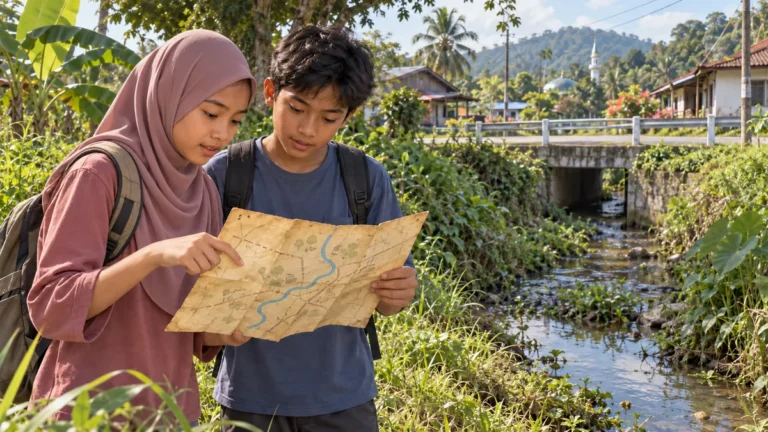
Instead, he spent the evening walking around the field with Grandpa.
They measured rough distances with a tape measure.
They marked possible places in Amir's notebook.
Some areas were crossed out immediately.
Too close to the road.
Too near a drain.
Not enough space.
By the time they finished, Amir had learnt something unexpected.
Planting trees was much easier to imagine than to do properly.
Over the next few days, Amir asked for help.
His teacher contacted the neighbourhood committee.
Grandpa spoke to several residents.
A local nursery offered ten young native and shade-tree saplings after hearing about the project.
On Saturday morning, Amir arrived at the field carrying a small shovel.
Harith was already there.
“You came?”
“You said ten trees,” Harith replied. “I wanted to see whether you were serious.”
Soon, several other children arrived with their parents.
Grandpa placed ten wooden markers on the ground.
Amir counted them twice.
“One, two, three… nine, ten.”
Ten holes.
Ten saplings.
For the first time, his idea looked real.
The first hole was harder than Amir expected.
After only a few minutes, his arms began to ache.
“Still want ten?” Harith asked.
Amir wiped sweat from his forehead.
“Yes.”
“Good. Because I've only dug half of one.”
They continued.
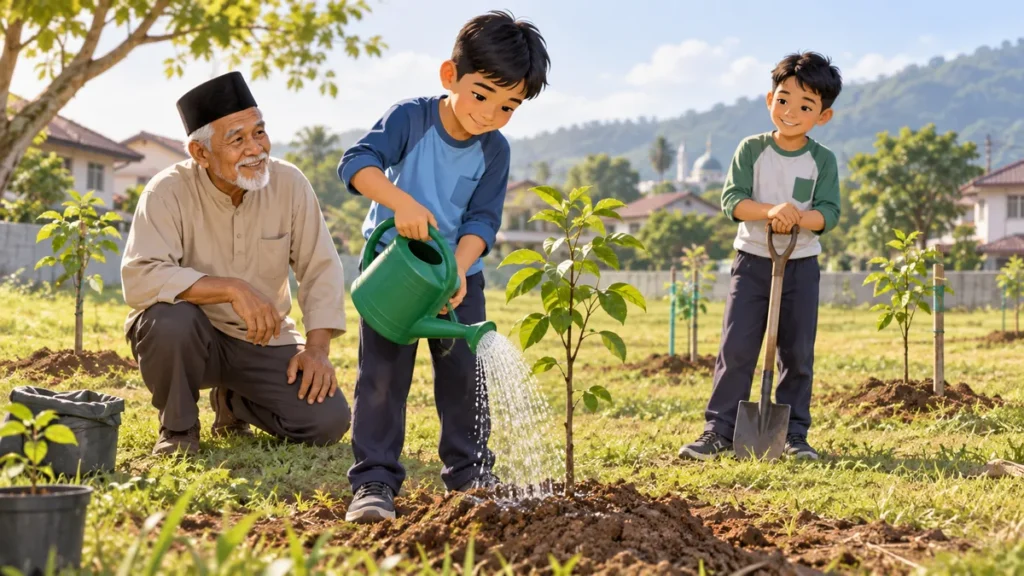
Adults helped with the deeper holes, while the children carried soil, moved tools and fetched water.
By late morning, ten young trees stood in the field.
They did not look impressive.
Their trunks were thin.
Their branches were small.
Most were hardly taller than the children.
Harith stood beside one of them.
“This is it?”
Amir looked at the ten tiny trees.
He had imagined the field changing immediately.
It had not.
The sun was still hot.
There was still almost no shade.
For a moment, he felt disappointed.
Grandpa seemed to understand.
“Trees don't work quickly,” he said.
Amir stared at the nearest sapling.
“How long before they're big?”
“Years.”
“Years?”
Grandpa smiled.
“You wanted trees, not umbrellas.”
The difficult part began after planting day.
Every afternoon that did not bring enough rain, Amir carried water to the saplings.
At first, Harith joined him.
Then school became busier.
Football practice started.
Some days Amir almost forgot.
Once, he remembered only after dinner and had to go with Grandpa while the sky was already growing dark.
“This is more work than I thought,” Amir admitted.
Grandpa poured water slowly around one sapling.
“Most useful things are.”
A few weeks later, one tree began to lose its leaves.
Amir panicked.
“It's dying!”
Grandpa checked the soil and branches.
“Maybe. Maybe not. Let's watch it carefully.”
They adjusted the watering and kept checking it.
Several days later, tiny new leaves appeared.
Amir called Harith over just to show him.
“You made me walk here to see three leaves?”
“They weren't here yesterday.”
Harith looked at the leaves again.
“All right. That's actually quite good.”
Months passed.
The trees grew slowly.
So slowly that Amir often felt they were not growing at all.
Then one morning, he found the photograph his teacher had taken on planting day.
He carried it to the field.
In the picture, each sapling was thin enough to hold with one hand.
Now several were taller than Amir.
He stood beside the largest one and smiled.
Harith looked from the photograph to the tree.
“You've become shorter.”
Amir pushed him lightly.
“The tree grew.”
“Same thing.”
A year after planting day, the field was still not a forest.
Nobody would have called it one.
But it was no longer exactly the same field either.
Birds sometimes landed on the higher branches.
Two benches had been placed nearby by the neighbourhood committee.
During one particularly hot afternoon, Amir noticed a younger boy sitting beside one of the trees.
The tree was still small, but its leaves cast enough shadow to cover half the bench.
The boy moved closer to the shaded side.
Amir stopped walking.
Grandpa's words returned to him.
One tree is better than none.
He finally understood.
The ten trees had not transformed the field in one dramatic moment.
The change had happened quietly — one watering can, one new leaf and one season at a time.
Several weeks later, Amir's teacher asked the class about the neighbourhood projects they had started the previous year.
When Amir's turn came, she asked, “Did you finish your tree project?”
Amir thought about the question.
He remembered digging the first hole, carrying water and worrying about the tree that lost its leaves.
Then he shook his head.
“Not really.”
His teacher looked surprised.
“But you planted all ten.”
“Yes,” Amir said. “Planting them was only the beginning.”
That afternoon, he returned to the field with a watering can.
The sun was still bright, but a small patch of shade now stretched across the ground.
Amir placed the watering can beneath the largest tree.
Above him, the leaves moved gently in the wind.
Ten small trees were still growing.
And so was the promise he had made to look after them.
Values
Responsibility — Amir continues caring for the trees after the excitement of planting day ends.
Patience — he learns that meaningful change can take a long time.
Cooperation — the project succeeds because family members, neighbours, teachers and friends help.
Uji Kefahaman
Cuba jawab tanpa melihat semula terlebih dahulu.
Aktifkan JavaScript untuk menjawab kuiz interaktif.
Fikir & Jawab
Bina Rumusan Anda
Cuba tulis 2–3 ayat menggunakan perkataan sendiri.
- Why did Amir first decide to plant ten trees?
- What did Amir learn before the trees could be planted?
- Why was Amir disappointed immediately after planting day?
- What helped him realise that the trees had actually grown?
What did Amir mean when he said, “Planting them was only the beginning”?
Catatan ini tidak dihantar atau disimpan oleh NilamOnline. Salin catatan sendiri sebelum meninggalkan halaman jika mahu menyimpannya.
Maklumat Bacaan
- Tajuk
- The Boy Who Planted Ten Trees
- Pengarang
- M. Naqeeb
- Penerbit
- Edura Creative
- Tahun
- 2026
- Bahasa
- Bahasa Inggeris
- Jenis
- Artikel Web
Salin secara manual
Anda akan dibawa ke portal rasmi AINS dalam tab baharu. NilamOnline bukan portal rasmi AINS atau KPM.
Sumber bacaan
- Planting a Tree ↗ — International Society of Arboriculture
- Tree Selection and Placement ↗ — International Society of Arboriculture
- New Tree Planting ↗ — International Society of Arboriculture