Why Do Shadows Move?
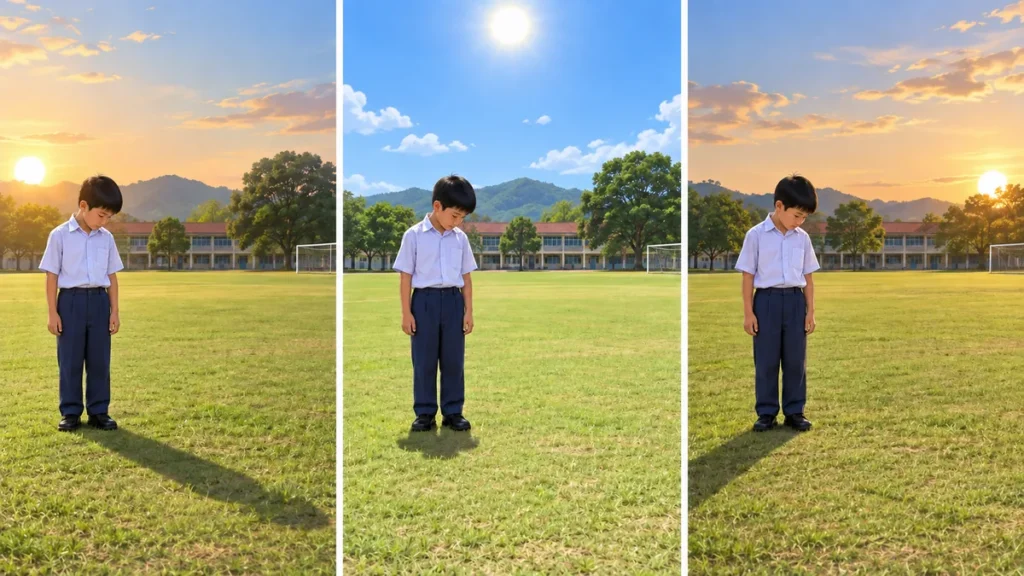
Kredit imej: Nilam Online / Edura Creative — ilustrasi dijana dengan AI.
🏫 Sokong sekolah anda dalam Liga Membaca Nilam Online
Pilih sekolah anda supaya bacaan anda nanti boleh membantu sekolah naik dalam ranking bulanan.
🏫 Sekolah Anda
Anda masih boleh membaca tanpa memilih sekolah.
Taip sekurang-kurangnya 2 aksara, kemudian pilih sekolah daripada hasil carian.
Have you ever noticed your shadow in the morning?
It may stretch far across the ground, making your legs look much longer than they really are.
A few hours later, the same shadow may become much shorter. By late afternoon, it grows long again — but points in a different direction.
You have not changed height.
So why does your shadow seem to move?
The answer comes from light, the position of the Sun, and the rotation of Earth.
How is a shadow made?
A shadow forms when an object blocks light.
Imagine shining a torch at your hand in front of a wall. Some of the light reaches the wall, but your hand blocks part of it. The darker shape behind your hand is its shadow.
Outside during the day, our main source of light is the Sun.
Trees, buildings, people and other objects block some of that sunlight. This creates shadows on the ground or on nearby surfaces.
A shadow is therefore not a dark object that follows us around.
It is an area where less light reaches because something is blocking the light.
Why does a shadow change during the day?
The Sun appears to travel across the sky from east to west.
In the morning, it is low in the sky. Around the middle of the day, it appears much higher. Later, it becomes low again as sunset approaches.
But the Sun is not actually circling Earth once every day.
Earth is rotating on its axis.
As Earth turns, our view of the Sun changes. This makes the Sun appear to move across the sky.
Because sunlight reaches objects from different angles throughout the day, their shadows change too.
Why are morning shadows so long?
Imagine placing a torch close to the side of a toy.
The light strikes the toy from a low angle. Its shadow stretches a long way across the floor.
Morning sunlight behaves in a similar way.
When the Sun is low near the horizon, its light reaches objects at a low angle. This produces long shadows.
As the Sun appears higher in the sky, the angle changes and the shadow becomes shorter.
That is why a tree may cast a very long shadow early in the morning but a much shorter one around midday.
What happens in the afternoon?
After reaching its highest part of its daily path, the Sun appears to move lower in the sky again.
The shadows begin to lengthen.
However, they now point in a different direction from the shadows seen in the morning.
This happens because the light is arriving from another direction.
So, during one sunny day, a shadow can change both its:
- length
- direction
The object itself may stay in exactly the same place.
Can a shadow move even if the Sun is not involved?
Yes.
Try using a torch indoors.
Place a small toy on a table and shine the torch towards it.
Now move the torch slowly to one side.
The toy has not moved, yet its shadow changes position.
Move the torch higher.
The shadow becomes shorter.
Move it lower.
The shadow becomes longer.
This happens because the position and angle of the light source affect the size, shape and position of a shadow.
Outdoors, the effect looks similar, although the reason is different: Earth is rotating, so our view of the Sun changes throughout the day.
Do all shadows have sharp edges?
Not always.
On a bright, sunny day, shadows often look darker and have clearer edges.
On a cloudy day, sunlight is scattered by clouds and the atmosphere. Shadows can become faint or may be difficult to see clearly.
The type and position of the light source also affect how sharp a shadow appears.
That is why the shadow from a small torch may look different from the shadow created by a large room light.
Can shadows help us tell time?
People have observed the changing position of shadows for thousands of years.
A sundial uses the Sun and a shadow to help show the time of day.
As Earth rotates and the Sun appears to change position, the shadow on the sundial moves across marked positions.
Modern clocks are far more accurate and convenient, but sundials show something important: the movement of shadows follows a pattern rather than happening randomly.
NASA notes that observing the Sun's position has long helped people recognise patterns and can still be useful in areas such as navigation, building design and solar-energy planning.
Try observing your own shadow
On a sunny day, choose a safe open place.
Look at your shadow in the morning.
Notice:
- which direction it points;
- how long it looks.
Check again around midday and later in the afternoon.
You may even mark the end of the shadow with chalk if an adult or teacher says it is safe to do so.
Do not stare directly at the Sun. You only need to observe the shadow on the ground.
You should notice that the shadow does not stay in one place all day.
Its movement gives us a clue that the position of the Sun appears to change as Earth turns.
A moving shadow tells a bigger story
A shadow may seem like a simple dark shape on the ground.
But watch one for several hours and it can tell you something much larger about our planet.
The tree remains where it is.
The school flagpole does not walk across the playground.
Yet their shadows slowly change direction and length.
The reason is happening on a much larger scale:
Earth is turning.
So the next time your shadow stretches across the ground, look at it again a few hours later.
It may be in a very different place — even though you are standing in exactly the same spot.
Uji Kefahaman
Cuba jawab tanpa melihat semula terlebih dahulu.
Aktifkan JavaScript untuk menjawab kuiz interaktif.
Fikir & Jawab
Bina Rumusan Anda
Cuba tulis 2–3 ayat menggunakan perkataan sendiri.
- What must happen for a shadow to form?
- Why are shadows usually longer when the Sun is low in the sky?
- Does the Sun really travel around Earth every day?
- What happens to a toy's shadow when a torch is moved?
How could you use your own shadow to observe changes during the day?
Catatan ini tidak dihantar atau disimpan oleh Nilam Online. Salin catatan sendiri sebelum meninggalkan halaman jika mahu menyimpannya.
Maklumat Bacaan
- Tajuk
- Why Do Shadows Move?
- Pengarang
- S. Musa
- Penerbit
- Edura Creative
- Tahun
- 2026
- Bahasa
- Bahasa Inggeris
- Jenis
- Artikel Web
Salin secara manual
Anda akan dibawa ke portal rasmi AINS dalam tab baharu. Nilam Online bukan portal rasmi AINS atau KPM.
Sumber bacaan
- Light and shadows ↗ — Science Learning Hub / University of Waikato
- Shadows: Effects of absence of light ↗ — Science Learning Hub / Ministry of Education NZ
- Angle of the Sun rays ↗ — NASA Goddard
- Navigation ↗ — NASA Goddard
- Create a Sundial Activity ↗ — NASA